Prototype, Sales Sample, Production Sample: The Three Samples You Need Before a Bulk Order
Ask an experienced importer what went wrong on their worst order and the answer is rarely "the factory was dishonest." It is usually something more uncomfortable: the factory sent exactly what was specified, and the specification was approved on the strength of an object that was never going to be shipped. The sample was real. It just was not the product.
Sourcing conversations tend to treat "the sample" as one thing. It is at least three, and they prove different things. Knowing which one you are holding — and insisting on all three in the right order — is the cheapest insurance available in cross-border buying. The examples below use real published specifications from two unrelated categories, sensory toys and frameless shower hardware, because the logic turns out to be identical in both.

The Three Samples, and Why They Are Not the Same Object
The first is the sales sample: the unit a supplier pulls from existing stock or an existing catalogue line to show you what they make. It is honest about their capability and silent about your order. The second is the prototype or pre-production sample: the first article made to your specification, often hand-assembled, with the custom colour, custom packaging or custom tooling you asked for. It proves the specification is understood. The third is the production sample: a unit pulled from the actual production run, made on the final tooling, with the final material batch, the final closure and the final printing. It is the only one of the three that tells you what the container will contain.
Most disputes trace back to a buyer approving the first and assuming they had approved the third. The gap between them is not fraud; it is the ordinary accumulation of substitutions. A lid from a different mould. A binder from a different batch. A fitting that was solid in the catalogue photograph and hollow in the box.
What the Sales Sample Proves
A sales sample proves that the factory can operate. It does not prove that your configuration works. Consider a sensory sand line published as natural sand plus a non-toxic bonding agent, graded 5+, sold in two formats: a set with mould accessories at a listed price of 2.99, and the plain play sand at 1.31. If a buyer evaluates the set and orders the refill — or evaluates one and negotiates against the other — the sales sample has answered a question nobody asked.
The same pattern appears in hardware. A shower support bar catalogue lists a wall-to-glass bar and a glass-to-glass bar on identical 3/5″ (15 mm) square tubing with solid stainless steel fittings, both rated for 1/4″ to 2/5″ (6 to 10 mm) monolithic tempered glass, both requiring no hole drilling. A sample of one tells you very little about the other in the field, because the difference between them is the termination, and the termination is where the load goes.
So use the sales sample for what it is good for: a first filter on build quality, material feel and finish consistency. Then move on.
Production Samples: Testing the Claims That Actually Fail
Every product carries claims that are cheap to print and expensive to discover were untrue. The discipline is to enumerate them before the production sample arrives, then test each one in a way that reproduces real conditions. Here are four claims from live product pages, with the test each one implies:
| Published claim | Where it appears | Test on a production sample | What failure looks like |
|---|---|---|---|
| Holds shapes without drying out; no water or special storage needed | Sensory sand, both formats | Open the tub as shipped, leave it exposed for a week on a bench, rework it daily | Surface crusting that does not reincorporate — usually a closure problem, not a formulation problem |
| Sticks to itself, not to hands, clothes or carpets | Sensory sand, mess-free claim | Press into carpet offcut and into a cotton swatch, then lift | Residue transfer; the claim parents and teachers actually repeat |
| Self-hardens in about 24 hours; can be painted, carved or sanded after drying | Ultra light air-dry clay | Cure one piece at room humidity, then sand and paint it | Tacky core or cracking at edges — the reason a second clay SKU declares it will not crack while modelling |
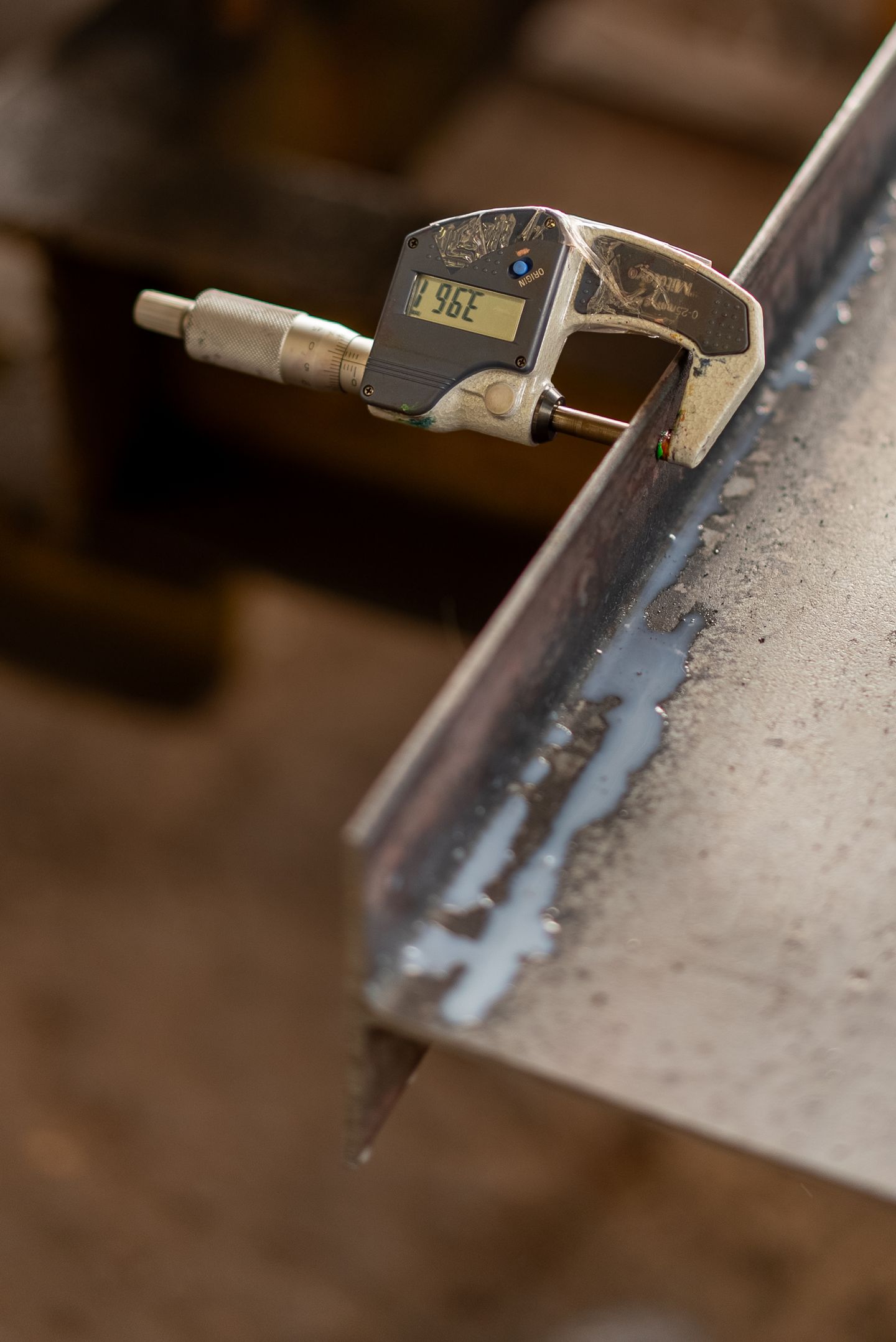
| Solid stainless steel fittings for 6–10 mm glass, no hole drilling required | Shower support bars and brackets | Confirm fitting construction against the quote, then clamp to actual glass thickness and measure deflection at mid-span | Visible movement under hand load; almost always a hollow fitting substituted for a solid one |
Notice that three of those four tests are about the container, the closure or the fitting — not about the headline material. That is typical. Headline materials are easy to control and easy to verify. The failures live at the interfaces.
Specification Drift: Where Numbers Quietly Change
Drift happens in the fields nobody re-reads after the first email. In sensory products, the two that matter most are the age grading and the customisation scope. A catalogue can declare one sand product as available with custom packaging and its sibling as available as a custom set. Those are different commercial commitments: the first means existing fill in your artwork, the second means the contents themselves can be re-specified. A buyer who assumes they bought the second and receives the first has no complaint, because the supplier delivered exactly the scope that was published.
In hardware, drift shows up in dimensions and ratings. A support bar family published at 15 mm square tubing with solid stainless steel fittings sits alongside a brass square tubing reference at the same 15 mm size with hollow brass fittings, and a round brass pipe at 3/4″ (19 mm) diameter with hollow brass fittings. Three products, two constructions, one of which is described honestly as hollow. If your purchase order says "brass fittings" and nothing else, you have specified an outcome, not a part.
The fix is unglamorous and takes ten minutes: copy the published specification fields onto your purchase order verbatim, including the words "solid" and "hollow," including the glass thickness range, including the finish code. If the supplier's order confirmation echoes those words back, you have an enforceable spec. If it paraphrases, you do not.
A Worked Example: Reading a Glass Thickness Rating
Of all the fields a buyer can misread, glass thickness ratings are the most expensive, because the mistake is discovered after the glass has been cut and tempered. In the shower hardware catalogue referenced here, the support bars and the -15 bracket series are published for monolithic tempered glass with 10 mm, 8 mm and 6 mm marked compatible — and 1/2″ (12 mm) not rated. Meanwhile the towel bar and handle combos in the same catalogue, built in brass with 3/4″ (19 mm) diameter tubing, are declared for 1/4″ (6 mm) to 1/2″ (12 mm) glass, and are offered in 6″ to 30″ centre-to-centre spacing.
That single matrix changes the specification for any enclosure built on 12 mm panels. The stabilising hardware either comes from a range rated to 12 mm, or the stabilising function is delivered by a combination product that is. It is not a paperwork detail, and it is not something a supplier will volunteer on a quote for a bar they assume is going on 10 mm glass.
The general lesson: a compatibility matrix is a limit, not a suggestion, and the blank cell in the table is the most informative cell. Train yourself to look for the row that is not ticked. Our own write-ups on specifying shower support bars and brackets go through that matrix line by line, and the sensory-side equivalent is covered in the sensory sand specification guide, where the equivalent trap is buying a set configuration when you negotiated a refill price.
Building the Approval Document
Approval should produce a document, not a message. Six fields is enough for most orders:
- The material declaration as published, copied verbatim — for example "natural sand + non-toxic bonding agent," not "sand."
- The compatibility limits, including the values that are not covered.
- The construction words that carry cost: solid versus hollow, 304 versus brass, 15 mm versus 19 mm.
- The customisation scope: custom colour, custom set, custom packaging or private label — named individually, because they are different products.
- The finish or surface code (PSS, SSS, and so on), matched across every item in the assembly.
- Photographs of the actual production sample, including the closure, the fitting cross-section and the printed label, attached to the approval.
Then hold one unit back. A retained production sample, stored sealed and labelled with the order number, turns any later dispute from an argument about memory into a comparison between two objects sitting on a table.
Frequently Asked Questions
Is a pre-production prototype enough to approve an order?
No. A prototype proves the factory understood your specification; it does not prove the production line reproduces it. Prototypes are frequently assembled by hand, from a different material batch, with a closure or fitting that is not the series part. Approve the prototype for design intent, then approve a unit pulled from the run for release.
Why do two products with the same declared material differ so much in price?
Configuration, not material. Two sensory sand products in one catalogue declare an identical material and sell at 1.31 and 2.99 — the difference is that one is a set with mould accessories and the other is the sand alone. Always check whether you are pricing the material or the configuration.
What is the single most commonly missed field on a hardware spec?
Fitting construction. The same 15 mm square tube appears with solid stainless steel, solid brass and hollow brass fittings across three references in one catalogue. If the purchase order does not say which, you have specified an appearance rather than a part.
How should a buyer handle a compatibility rating that stops short of their requirement?
Treat the blank cell as a hard limit. Where a support bar range is rated to 10 mm and the project specifies 12 mm panels, the answer is a product rated to 12 mm, not an exception granted on site — because the glass will already have been tempered by the time the problem appears.
Does holding a retained sample actually help?
It converts a dispute about recollection into a physical comparison, and it costs one unit per order. On any claim involving material batch, closure integrity or fitting construction — which is to say, on most claims — that is the difference between a credit note and a stalemate.
Conclusion
The three samples exist because they answer three different questions: can this factory make it, does this factory understand my specification, and will the container match what I approved. Buyers who collapse those into one approval step are not being careless — they are following a process that feels efficient right up until it is not.
The cost of doing it properly is small. One more round of sampling, a specification copied verbatim onto the purchase order, four bench tests on the claims that actually fail, and one unit held back under a label. Compared with a container of product that performs perfectly in the sample tub and fails in the customer's hands, that is the cheapest insurance in the business.
Standards and references. ASTM International; ASTM F963; Incoterms


评论
发表评论